
Introduction
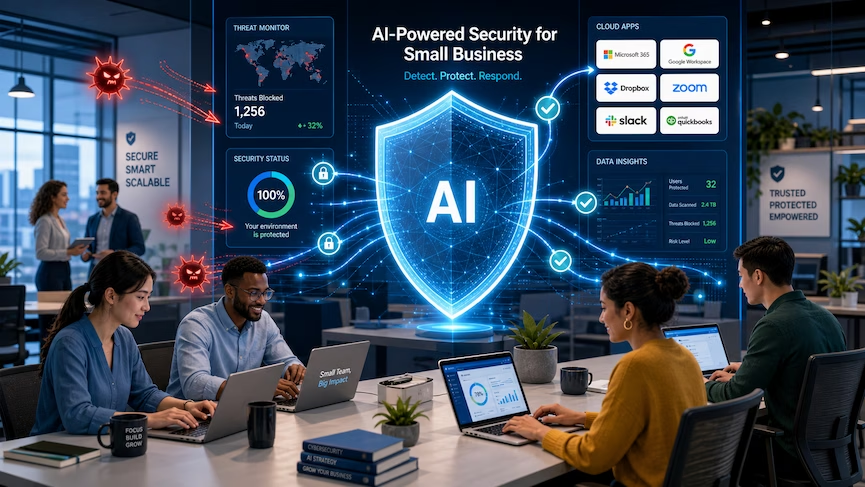
Over the past several months, a lot of the conversation around AI and security has focused on how attackers are using it against businesses. From AI-powered phishing and impersonation to risky browser plug-ins and Shadow AI, the message has often been about how artificial intelligence can create new vulnerabilities if it is used carelessly or maliciously. This time, it is worth flipping the lens: AI is not only something businesses need to defend against, but also something they can use to strengthen their own security posture when it is deployed thoughtfully.
AI is now appearing in more security products than ever, from email filtering and endpoint detection to threat hunting and managed detection services. For small businesses, that can be a real advantage—if AI is treated as a force multiplier for strong security practices instead of a shortcut that replaces them. The real question is not whether AI belongs in your security stack, but how to use it without making your environment harder to understand, govern, and trust.
In This Article
Why AI is getting so much attention in cybersecurity
Security vendors are leaning heavily into AI because it can process huge amounts of data faster than people and spot unusual behavior that older signature-based tools often miss. In current 2026 trend reporting, organizations are prioritizing AI-powered security tools alongside better integration across their existing environments, reflecting the need for faster detection in cloud-heavy, remote-friendly businesses.
That matters because the threat landscape has changed. Attackers are also using AI to automate phishing, speed up reconnaissance, vary attack patterns, and scale low-cost attacks that once required much more effort. As a result, small businesses are under pressure to modernize defenses without adding a full internal security operations team.
Where AI can genuinely help your security stack
Used well, AI can improve visibility and shorten response time in several areas that matter to SMBs.
- Email security: AI-enhanced filtering can help catch suspicious language, impersonation attempts, and behavior patterns that traditional filters may miss.
- Endpoint Detection and Response (EDR): AI-driven EDR and XDR (Extended Detection and Response) tools can baseline normal device behavior and flag anomalies that suggest malware, credential misuse, or lateral movement.
- Managed Detection and Response (MDR): Modern MDR services increasingly combine AI-driven analytics with human analysts to reduce noise, prioritize meaningful alerts, and improve around-the-clock monitoring.
- Threat correlation and triage: AI can help connect events across endpoints, cloud apps, and network activity so your IT team or provider can spot patterns earlier and respond faster.
For lean teams, this can be a major benefit. AI can help sort through the volume of alerts and telemetry that would otherwise overwhelm small internal IT departments or a single overextended office manager.
Where AI can create new risk
The value is real, but so are the risks. Some businesses make the mistake of assuming that if a security product says “AI-powered,” it must automatically be more effective or easier to trust.
In practice, several problems can arise:
- Blind trust in automation: AI tools can surface suspicious behavior, but they still need oversight, tuning, and human judgment—especially when automated responses could disrupt users or business operations.
- Poor visibility into how decisions are made: Some vendors market AI aggressively without giving enough clarity into what their tools analyze, how they score risk, or what happens to the data they ingest.
- More tool sprawl: Adding another AI dashboard or overlapping detection product can make your stack noisier and harder to manage if it is not integrated thoughtfully.
- Governance gaps: If no one clearly owns evaluation, deployment, and review of AI-driven tools, you can end up with powerful automation layered onto weak processes.
In other words, AI can amplify strong security programs—but it can also amplify confusion when it is dropped into an environment without clear ownership and guardrails.
Questions to ask before adding AI to your security stack
Before adopting an AI-powered security tool or service, it helps to slow down and ask a few practical questions.
What problem is this tool actually solving?
Start with the gap, not the buzzword. Are you struggling with phishing, after-hours monitoring, noisy alerts, weak endpoint visibility, or slow incident response? If the answer is vague, the tool probably is not the right place to start.
What data does it need?
AI-based detection often works by ingesting logs, endpoints telemetry, identity activity, cloud events, or email metadata. You should know what data is collected, where it is stored, how long it is retained, and whether it is used to train broader models.
How does it fit with what you already use?
The best AI tools improve your visibility and reduce noise across existing systems; the worst become another disconnected console nobody checks consistently. Ask how the product integrates with your email platform, endpoint tools, identity provider, cloud applications, and ticketing or response workflows.
Who is reviewing and acting on the output?
Detection only matters if someone is responsible for validating alerts and taking the next step. For many SMBs, that means working with an IT partner or MDR provider rather than expecting internal staff to monitor alerts full time.
What happens when the tool is wrong?
False positives and false negatives are part of any detection technology. You need to understand how incidents are escalated, how automated actions are controlled, and how your team can override or tune the system when it behaves unexpectedly.
What a healthy approach looks like for small businesses
For most SMBs, the best use of AI in security is not replacing everything you already have. It is strengthening the right layers in a measured way.
A practical, lower-risk approach often looks like this:
- Start with foundations first: strong MFA, secure identity practices, patching, backups, endpoint protection, and clear response processes still matter more than any AI feature.
- Add AI where it solves a clear operational problem: for example, reducing phishing risk, improving endpoint visibility, or extending monitoring after hours.
- Pair automation with people: the strongest outcomes come when AI-driven detection is combined with experienced analysts or a trusted IT partner who can interpret context and act appropriately.
- Review and tune regularly: AI tools should be evaluated over time for usefulness, alert quality, integration value, and business impact—not treated as a set-it-and-forget-it purchase.
This is especially important for small businesses, where every extra product adds overhead. The right AI tool should simplify your security operations, not create another blind spot.
A simple 90-day plan
If you are considering AI-powered security tools, a short planning window can help you move carefully instead of impulsively.
Month 1: Identify priorities
Review your recent incidents, current controls, and biggest pain points. Decide whether your top need is better phishing protection, stronger endpoint detection, improved monitoring, or better alert triage.
Month 2: Evaluate fit and governance
Shortlist one or two tools or services and ask detailed questions about data use, integration, tuning, and oversight. Decide who internally—or through your IT partner—owns the rollout and ongoing review.
Month 3: Pilot and measure
Test the tool in a limited way, measure alert quality and operational value, and confirm that it improves your existing stack instead of complicating it. Use those results to decide whether to expand, adjust, or walk away.
That kind of phased approach helps you avoid chasing AI because it is fashionable, and instead focus on whether it actually strengthens your security posture.
Conclusion
AI has a real place in modern cybersecurity, especially for small businesses that need more visibility and faster response without building a full security team from scratch. But the smartest path is not to hand over security to automation—it is to combine AI-driven tools with strong fundamentals, clear governance, and people who know how to respond when something looks wrong.
If you are sorting through AI-powered security products and want a practical second opinion, ExcalTech can help. Our team can review your current security stack, identify where AI-driven tools may add real value, and help you choose solutions that fit your business without adding unnecessary complexity or risk.