
Introduction
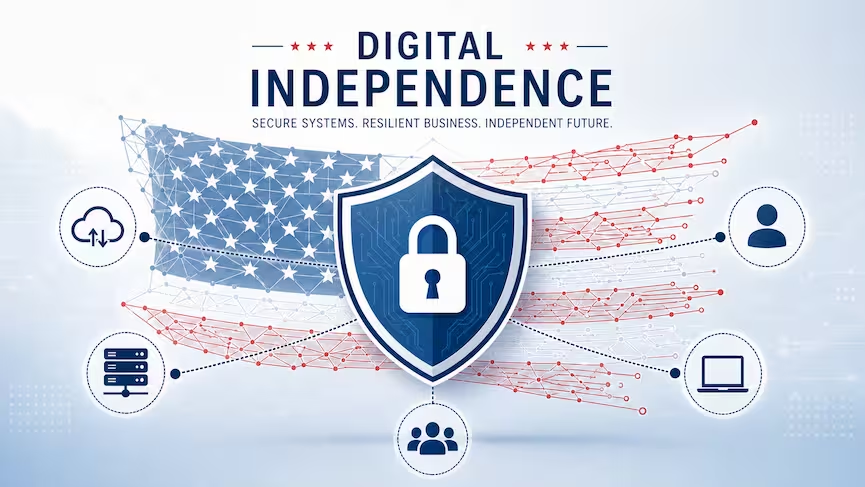
Every July, we celebrate independence from relying on a single distant power. In 2026, most small businesses need a different kind of independence: freedom from single points of failure in their tech, vendors, and people. Digital independence isn’t about avoiding trusted partners like ExcalTech—it’s about making sure no single person, device, or tool can stop your business in its tracks.
In This Article
Why Digital Independence Matters
Being overly dependent on one element of your environment—one key employee, one device, or one platform—is risky for three reasons:
- It increases downtime risk. If that one thing fails, your operations can slow down or stop.
- It reduces flexibility. When switching tools or adjusting workflows is difficult, you have fewer options when your needs change.
- It magnifies security impact. A single compromised account, system, or person can give attackers a straight path into your business.
ExcalTech’s role is to reduce these risks by acting as a central, accountable partner who uses multiple tools, platforms, and safeguards behind the scenes—so your “single vendor” isn’t a single point of failure.
Spotting Your Single Points of Failure
You can’t fix what you don’t see, so start by identifying areas where you’re relying on “just one” in a fragile way:
- One person: A staff member who is the only one who knows a critical process, system, or password.
- One device or system: A lone server, router, or workstation that must stay online for you to serve customers.
- One tool or app with no backup plan: A line-of-business application that would be difficult to replace quickly if it fails or the vendor changes direction.
A practical way to find these risks is to ask simple “what if” questions: What happens if this person is out tomorrow? What breaks if this system goes offline? How quickly could we recover if this application became unavailable? Wherever the honest answer is “we’re not sure” or “everything stops,” you’ve found a dependency ExcalTech can help harden.
Making Managed IT a Source of Independence, Not Fragility
When all your IT runs through one provider, the question isn’t “do we have a single vendor?”—it’s “does that vendor design our environment for resilience?” Good managed IT reduces lock-in risk by giving you structure and options:
- Control over your data. Your provider should help ensure your critical data is stored in ways that can be exported, backed up, and restored—not trapped in a single proprietary format.
- Thoughtful tool selection. Behind the scenes, a managed service partner can use multiple vendors and best-of-breed tools instead of relying on one platform for everything.
- Clear expectations. A good partner is transparent about how your data and systems would be handled if your needs change.
The aim is not to move away from a trusted IT partner, but to make sure that relationship increases your independence from individual tools, devices, and ad-hoc fixes.
Raising Your Bus Factor: Sharing Knowledge So One Person Isn’t a Risk
In many small organizations, the real single point of failure is human: “Only Alex knows how that works.” The bus factor highlights how dangerous it is when critical knowledge lives in one person’s head. To raise your bus factor:
- Document critical processes. Capture how to perform essential tasks, from onboarding new employees to restoring a backup or accessing key systems.
- Cross-train team members. Make sure at least one other person can step into each crucial role, even if only in an emergency capacity.
- Use managed, role-based access. Working with ExcalTech to centralize and standardize access controls ensures that no single employee’s personal account becomes your weak link.
Ask yourself: if your most knowledgeable person is unexpectedly out for two weeks, what truly breaks? The more honest the answer, the clearer the priorities for documentation, training, and where a managed service provider should be involved.
Building Technical Redundancy and Security Resilience
Independence from devices and systems is just as important as independence from people. A single, unmonitored, non-redundant system is a classic single point of failure. With a managed IT partner, redundancy can be designed in a practical, affordable way:
- Add redundancy for critical services. Use backup internet connections, multiple ways to reach cloud apps, and failover for key infrastructure rather than relying on one physical box in the office.
- Implement layered security instead of relying on one tool. Combine endpoint protection, email filtering, backups, and strong identity and access management, with a provider to monitor and tune these layers.
- Test your backups and recovery steps regularly. A backup that hasn’t been tested might as well not exist, so include recovery drills in your service plan.
Digital independence means designing an environment so that one broken device, one compromised account, or one vendor misstep doesn’t shut down the entire business.
Conclusion
Digital independence does not mean handling everything alone. It means building a business environment where the right partner, the right safeguards, and the right planning reduce the risk that any one person, device, or tool can disrupt operations. For many small businesses, that is exactly where a managed IT partner adds value: not by creating more dependency, but by replacing fragile, informal dependencies with a more resilient and well-supported foundation.
If you’re ready to strengthen your organization’s digital independence, connect with ExcalTech to review your current IT environment and single points of failure. A short conversation with a Technology Advisor can help you turn this year’s “Digital Independence Day” into concrete steps that safeguard your business for the long term.